How to Choose Between a Compact, Midsize and Full-Size Pickup Truck
October 21 2026,
The weekday version of a pickup truck rarely matches the one in the brochure. It’s a school drop-off, a grocery run, a tight parking stall at the office, and a bed that mostly carries a stroller and a bag of hockey gear. Then the weekend arrives with a load of mulch, a borrowed trailer, or two kayaks, and the same truck has to do a very different job. Choosing a pickup size comes down to being honest about both versions of that week.
The simplest rule is also the most useful one: choose the smallest pickup that comfortably handles the real passengers, cargo and trailer in your life, with some margin left over. A bigger truck costs more to fuel, park and manoeuvre every single day, and a well-chosen smaller one gives up nothing the owner actually uses. Every Ford pickup in the Carson Automotive Group lineup, from the compact Maverick to the heavy-duty Super Duty, makes a clear case for a particular kind of owner, and the right one depends on which of those owners you are.
Start With an Honest Needs Audit
Before comparing trucks, a few questions narrow the field quickly:
- How many people ride along on a typical day, and how often does the back seat carry adults rather than kids?
- What goes in the bed most weeks, and what’s the largest item it needs to carry a few times a year?
- Will the truck tow, and if so, what does the loaded trailer actually weigh?
- Where does the truck live and park: a roomy driveway, a tight garage, or an underground stall?
The answers to the third question matter most, because towing and payload separate the size classes more sharply than anything else. The fourth matters more than most buyers expect, since a truck lives in its parking spot far more hours than it spends working.
Compact: The Ford Maverick

The Maverick is Ford’s compact pickup, built on a unibody structure closer to a crossover than a traditional body-on-frame truck. It comes as a four-door SuperCrew that seats five, with a single bed length of 1,382 mm (54.4 in), roughly four and a half feet. That bed is designed around flexibility: the FLEXBED system uses a multi-position tailgate and slots for accessories, and the truck adds rear under-seat storage plus two prewired 12-volt connections in the bed for lighting or small gear.
Efficiency is where the Maverick stands apart from everything else in the lineup. The Maverick Hybrid with front-wheel drive is rated at 6.2 L/100 km combined, a figure closer to a compact car than a work truck. Properly equipped with all-wheel drive and the available 4K Tow Package, a Maverick can tow up to 4,000 lbs (1,814 kg), enough for a small utility trailer, a pair of personal watercraft or a small camping trailer. It suits the owner whose truck is a daily driver first and a hauler on weekends.
Midsize: The Ford Ranger
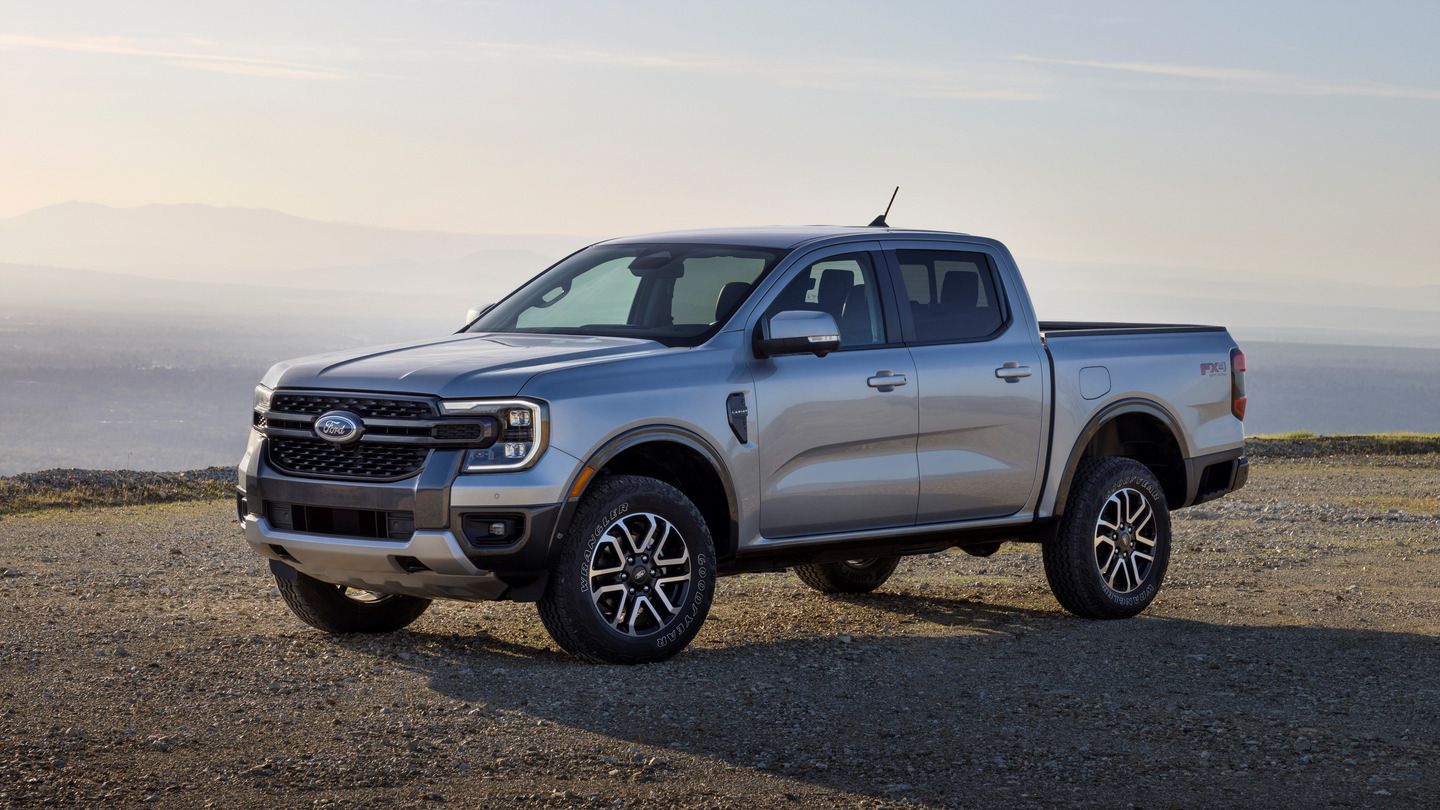
The Ranger steps up to a more traditional pickup layout and a bigger working envelope. In Canada it comes as a four-wheel-drive SuperCrew seating five, with a bed of 1,514 mm (59.6 in), nominally five feet. Ford positions it for work during the week and recreation on weekends, and the Raptor version adds serious off-road capability for owners who spend their spare time on trails and forestry roads.
Daily practicality runs deeper than the size suggests. The rear seats fold flat, there’s storage under them, an integrated step on the side of the box is available for easier bed access, and available 400-watt Pro Power Onboard outlets can run small tools or charge devices at a campsite or job site. The trade-off is fuel use: the Ranger with the 2.3 L four-cylinder engine and four-wheel drive is rated at 11.2 L/100 km combined, a sizable jump from the Maverick Hybrid. For owners who tow regularly or need four-wheel drive as standard, that jump buys real capability.
Full-Size and Heavy-Duty: The F-150 and Super Duty
The F-150 is where choice opens up dramatically. Ford offers Regular Cab, SuperCab and SuperCrew body styles and boxes nominally 5.5, 6.5 and 8 feet long, though not every cab pairs with every box, so the exact configuration is worth confirming in the order guide. The F-150 covers job-site work, family camper towing and long road trips with equal comfort, and it brings features that make daily use easier: an available Pro Access Tailgate that swings out 100 degrees and puts the user up to 48 cm (19 in) closer to the cargo, flip-up rear seats with storage beneath, an available interior work surface, and available Pro Power Onboard with up to 7.2 kW of output from outlets in the bed, enough to run serious tools or power a campsite.
The Super Duty is best understood as the heavy-duty branch of the full-size family rather than a fourth size class. Super Duty pickups such as the F-350 exist for owners whose trailers and payloads outgrow even a well-equipped F-150: large fifth-wheel campers, horse trailers, equipment trailers and work loads that never stop. Regular Cab models pair with an 8-foot box, while SuperCab and Crew Cab models offer 6.75- or 8-foot boxes, and integrated box-side steps, bumper-corner steps and available 2.0-kW Pro Power Onboard make a large truck easier to work around. Heavy-duty pickups also sit outside the standard fuel consumption reporting that covers lighter trucks, so they don’t appear alongside the Maverick, Ranger and F-150 in those tables, which says a good deal about how different their job is.
Towing and Payload: The Numbers That Actually Decide It
Three ratings separate a comfortable truck from an overworked one, and none of them is the headline towing figure on its own:
|
Rating |
What It Means |
Why It Matters |
|
Payload |
Passengers plus cargo the truck can carry |
Includes the trailer’s tongue weight pressing on the hitch |
|
GVWR |
Maximum allowed weight of the loaded truck |
Payload is GVWR minus the truck’s own weight |
|
GCWR |
Maximum combined weight of truck and loaded trailer |
Caps the entire rig, truck and trailer together |
Payload is the rating most often overlooked. A family of five, a cooler, a load of firewood and a trailer’s tongue weight can use up a truck’s payload long before the trailer reaches the towing maximum. The right reference is the label and towing guide for the specific truck, since ratings change with cab, box, engine, axle ratio and towing packages. A truck that only matches a trailer’s weight on paper, with no margin left, is the wrong size for that trailer.
Matching the Truck to the Life

For most owners, the decision lands quickly once the needs audit is done. Someone whose truck commutes daily, parks in tight spaces and tows a small trailer a few times a year will find the Maverick hard to beat. Someone who wants four-wheel drive, a bigger bed and more towing headroom in a size that still fits a city garage will gravitate to the Ranger. Someone towing a family travel trailer, hauling regularly or needing a long box and a full back seat belongs in an F-150, and the Super Duty is the step up for loads that are heavy every single time.
Carson Automotive Group’s Ford dealerships carry the full range from Maverick to Super Duty, and their sales teams can match a configuration to the specific trailer and payload a buyer has in mind, with every location listed on the group’s website.