PHEV vs. Mild Hybrid vs. Full Hybrid: What Each Powertrain Actually Means at the Pump
May 20 2026,
With fuel averaging around $1.90 per litre right now, the powertrain choice under the hood of your next vehicle carries more financial weight than it did five or ten years ago. Hybrid and electrified labels are appearing on more models than ever, but the terms are not interchangeable. A plug-in hybrid, a mild hybrid, and a full hybrid each save fuel in fundamentally different ways — and understanding those differences helps you figure out which one fits how you actually drive.
Carson Automotive Group in Victoria carries vehicles from Ford, Lincoln, Mazda, and Land Rover, and the current lineup spans all three of these powertrain categories. This guide breaks down how each type works, what you can realistically expect at the pump, and which drivers tend to benefit most from each approach.
The Three Electrified Powertrain Types Explained
Before running the numbers, it helps to understand what each type actually does.
Mild hybrid (MHEV): A mild hybrid adds a small electric motor and a compact battery to a conventional gasoline engine. The motor is not powerful enough to drive the vehicle on its own. Instead, it assists the engine during acceleration, smooths out stop-start cycles, and recovers a small amount of energy during braking. The result is a modest fuel-consumption improvement with no changes to how you use the vehicle — no plugging in, no EV mode, no range management.
Full hybrid (HEV): A full hybrid pairs a gasoline engine with a larger electric motor that is capable of propelling the vehicle at low speeds for short distances. At city speeds and during light acceleration, the electric motor does the work. The gasoline engine steps in when more power is needed. The battery charges itself through the engine and regenerative braking. No plug required.
Plug-in hybrid (PHEV): A plug-in hybrid has a significantly larger battery that you charge from a power outlet. Fully charged, a PHEV can cover a meaningful distance on electricity alone before the gasoline engine starts. On short daily commutes that fall within the electric range, a PHEV can go days between fuel stops. On longer drives, it operates like a full hybrid, using both sources. The bigger the battery and the more consistently you charge, the greater the fuel savings.
Mild Hybrid: A Useful Improvement, Without the Plug
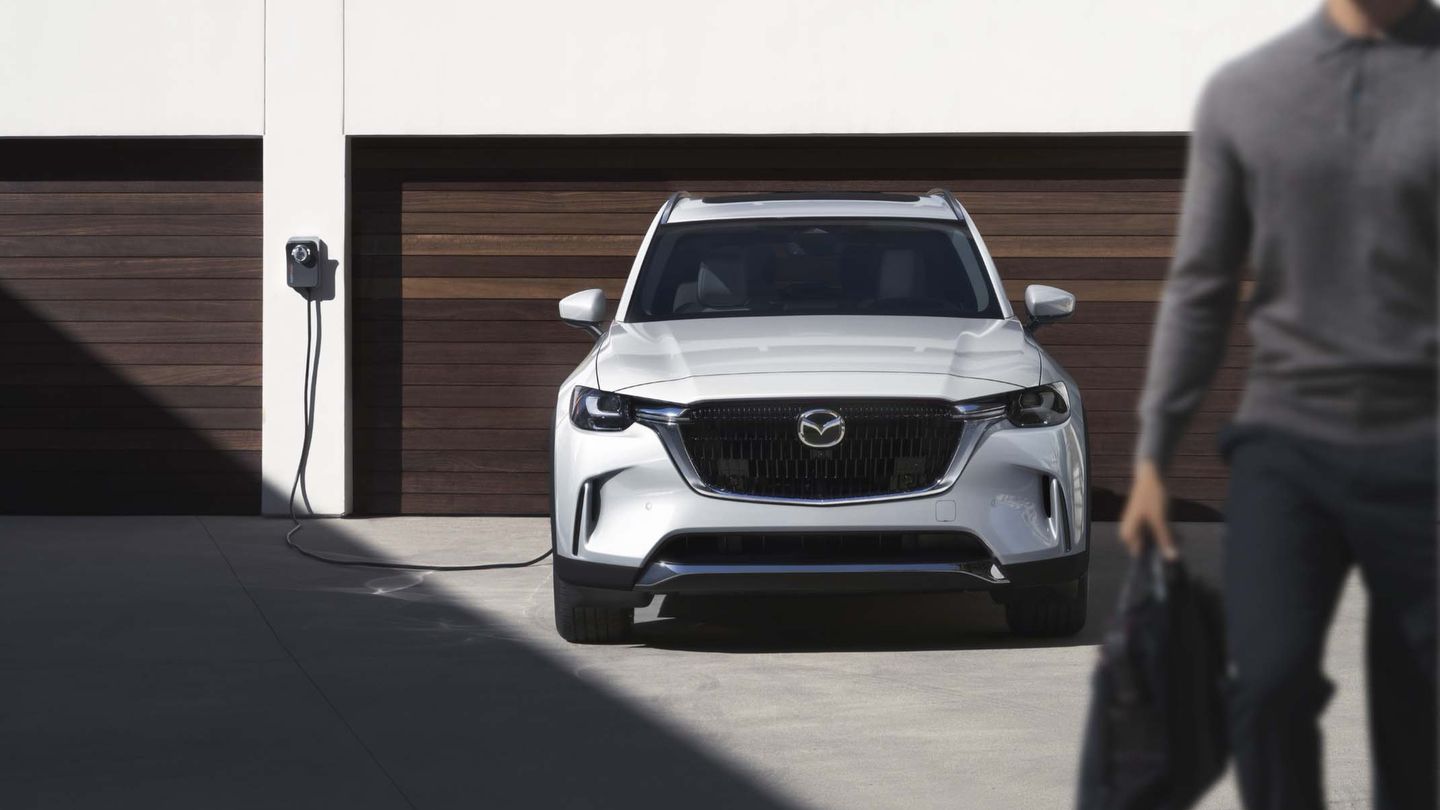
The Mazda CX-90 in its standard MHEV configuration pairs a turbocharged inline-six engine with a 48-volt mild-hybrid system. The electric assistance reduces the load on the engine during the moments that consume the most fuel: pulling away from a stop and climbing grades. The combined fuel consumption for the CX-90 MHEV is approximately 9.3 L/100 km.
At $1.90 per litre and 20,000 km per year, that works out to roughly 1,860 litres annually, or approximately $3,534 in fuel costs. That is the baseline to compare against.
The mild hybrid experience requires no adjustment to your routine. You fill up at the pump like any other vehicle. There is nothing to plug in and no EV range to manage.
Land Rover’s mild hybrid engines, available across the Range Rover lineup, use a 48-volt integrated starter-generator in a similar role. For the Range Rover mild hybrid variants, combined fuel consumption is in the range of 10.0 to 10.9 L/100 km depending on the engine and configuration — higher than the Mazda MHEV given the larger vehicle class, but meaningfully better than comparable non-electrified SUVs of similar size.
Full Hybrid: City Gains, No Charging Required
A full hybrid’s biggest advantage shows up in city driving. Stop-and-go conditions are where a conventional gasoline engine is least efficient and where the electric motor does its most useful work.
The Ford Escape Hybrid is a strong example of this category in Carson’s lineup. It uses a 2.5 L Atkinson-cycle 4-cylinder engine with an electric motor and self-charging battery. The combined fuel consumption is approximately 5.9 L/100 km, based on Government of Canada test ratings.
At $1.90 per litre and 20,000 km annually, that is around 1,180 litres and approximately $2,242 in fuel per year — a saving of roughly $1,292 per year compared to the CX-90 MHEV baseline above, with no charging infrastructure required.
For drivers who do most of their driving in town, cover moderate highway distances, and want to reduce fuel costs without adding the complexity of home charging, a full hybrid delivers a significant and consistent improvement.
Plug-In Hybrid: The Biggest Potential Savings, When You Plug In
A plug-in hybrid’s efficiency advantage is real, but it depends on one condition: you need to charge it regularly. A PHEV that is never plugged in is essentially a heavier full hybrid, and its fuel consumption in gasoline-only mode is higher than a purpose-built full hybrid.
The math changes dramatically when you charge consistently.
The Mazda CX-90 PHEV uses the same turbocharged inline-six as the MHEV, paired with a larger battery and a plug-in charging system. Its combined Le/100 km rating is approximately 4.2 Le/100 km, based on Government of Canada 5-cycle testing that assumes regular charging. At $1.90 per litre equivalent and 20,000 km annually, that works out to approximately 840 litres equivalent and roughly $1,596 per year in combined energy costs.
That is a saving of approximately $1,938 per year compared to the CX-90 MHEV. The tradeoff: the PHEV requires access to a charging outlet, ideally at home or at work, and the Le/100 km figure is directly tied to how often you plug in. If the battery is regularly depleted before recharging, the CX-90 PHEV’s gasoline-only combined consumption is approximately 9.4 L/100 km — comparable to the MHEV baseline.
The Ford Escape PHEV similarly uses a 2.5 L Atkinson-cycle 4-cylinder with a plug-in system and comes in at approximately 5.9 L/100 km on gasoline only, with the full efficiency benefit requiring regular charging.
For Land Rover, the Range Rover PHEV variants — including the P550e and related models — carry a Government of Canada NRCan rating of 4.4 Le/100 km combined, with approximately 85 km of all-electric driving range and a gasoline-only combined consumption of 11.0 L/100 km when the battery is depleted. At $1.90 per litre equivalent and 20,000 km annually with consistent charging, the PHEV fuel cost comes to roughly $1,672 per year, compared to approximately $4,180 at the gasoline-only rate. The difference is substantial, and it illustrates why regular charging matters for PHEV owners.
How the Numbers Compare
|
Powertrain |
Example Model |
Combined Rating |
Annual Fuel Cost (20,000 km at $1.90/L) |
|
Mild Hybrid |
Mazda CX-90 MHEV |
9.3 L/100 km |
~$3,534 |
|
Full Hybrid |
Ford Escape Hybrid |
5.9 L/100 km |
~$2,242 |
|
PHEV (with charging) |
Mazda CX-90 PHEV |
4.2 Le/100 km |
~$1,596 |
|
PHEV (with charging) |
Range Rover PHEV |
4.4 Le/100 km |
~$1,672 |
|
PHEV (no charging) |
Mazda CX-90 PHEV |
9.4 L/100 km |
~$3,572 |
All fuel economy figures are based on Government of Canada 5-cycle test ratings. Actual results vary with driving style, climate, route, and, for PHEVs, charging frequency.
Which Powertrain Fits Your Driving?
Mild hybrid fits drivers who want a modest fuel improvement without any change to their routine. No charging, no range management. Fill up normally and benefit from a slight reduction in consumption, particularly on varied routes with regular acceleration.
Full hybrid fits drivers who spend significant time in city traffic, cover moderate overall distances, and want a meaningful reduction in fuel costs without the need for charging infrastructure. The savings are consistent and require no behaviour change.
Plug-in hybrid fits drivers who can charge at home or work, whose daily driving falls within or near the vehicle’s electric range, and who want the greatest potential fuel savings over the long term. The PHEV advantage is real and significant — but only when the vehicle is charged regularly. If your situation does not include reliable access to a charger, a full hybrid is likely a better match.
If gas climbs above $2.00 per litre — a reasonable scenario given recent trends — these savings scale proportionally. At $2.10 per litre, a CX-90 MHEV driver would spend approximately $3,906 annually, while a CX-90 PHEV driver charging regularly would spend approximately $1,764. The gap widens with every cent the pump adds.
Talk Powertrains at Carson Automotive Group in Victoria
Understanding how these systems work is one thing. Experiencing the difference behind the wheel is another. Visit Carson Automotive Group in Victoria to explore the Mazda CX-90 MHEV and PHEV, the Ford Escape Hybrid and PHEV, and Land Rover’s PHEV-equipped models in person. The team can help you match the right powertrain to your driving patterns and figure out whether a home charger setup makes sense for your situation.
5 SEO Headline Alternatives
- PHEV vs. Hybrid vs. Mild Hybrid: What You Actually Save at the Pump in BC
- How Much Can You Save on Fuel Choosing a PHEV Over a Mild Hybrid at $1.90 per Litre?
- Mild Hybrid, Full Hybrid, or Plug-In: A Practical Breakdown for Canadian Drivers
- Mazda CX-90 MHEV vs. PHEV: The Real Fuel Cost Difference at Today’s Gas Prices
- Plug-In Hybrid vs. Self-Charging Hybrid: Which Saves More for BC Families?